Why I built it
Debugging SSO usually means decoding a SAML response, and most people paste it into an online decoder. A SAML response contains names, emails, roles and session identifiers. Pasting it online sends personal data to a third party, often from production. I wanted a tool that is as convenient but never leaves the machine, and that does more than pretty-print: it should tell you whether the message is safe to accept.
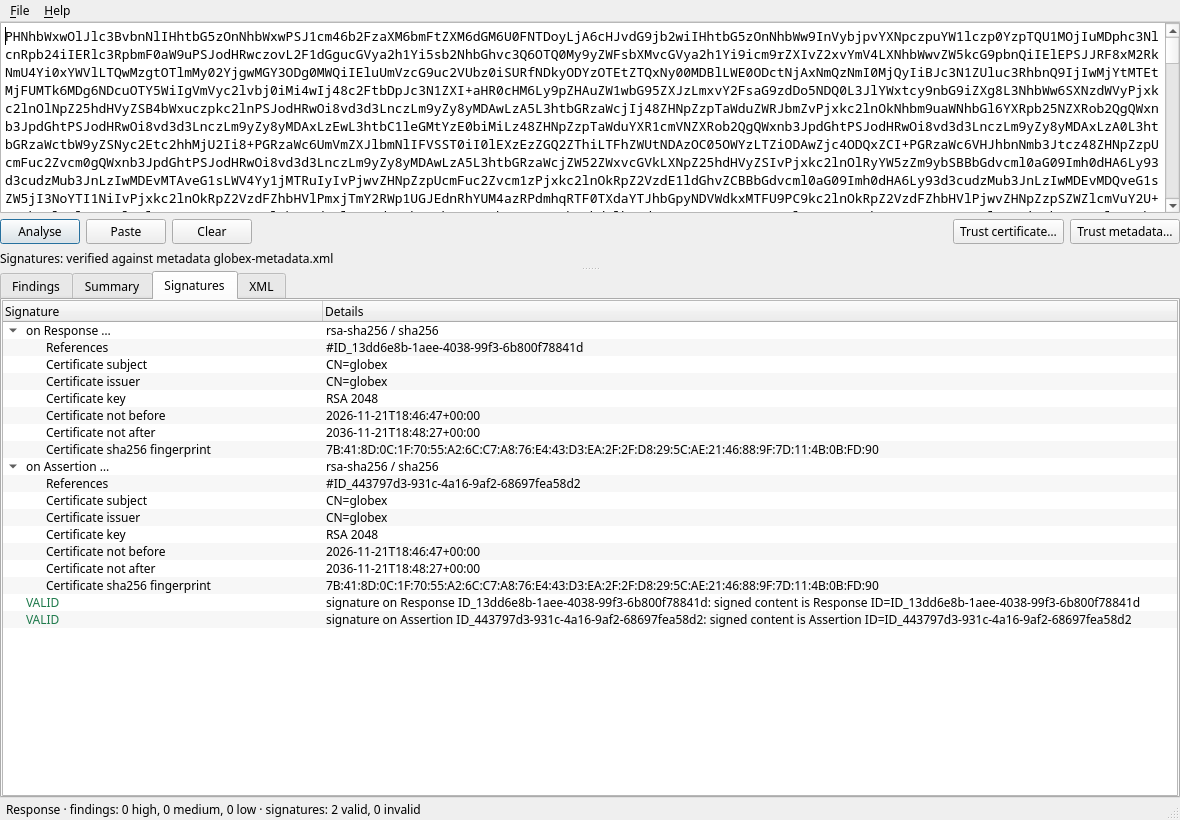
What it does
- Decodes anything: POST binding, Redirect binding (DEFLATE), full URLs, form bodies, URL-encoded values, raw XML.
- Verifies signatures against the certificate or metadata you trust, and reports which element each signature actually covers. That is the detail that defeats XML Signature Wrapping, where an attacker keeps the genuine signed assertion and adds a forged one.
- Exports the embedded signing certificate as PEM, DER, Base64 on one line, or exactly as in the message, for SP configuration or fingerprint comparison.
- Security lint: unsigned responses, signature-wrapping indicators, XML comments inside NameID (the CVE-2017-11427 family of truncation bugs), SHA-1, missing audience or recipient, long validity windows, expired keys.
Built like security software
| Risk for a tool that reads hostile input | Control |
|---|---|
| XXE, billion laughs | DOCTYPE and ENTITY declarations refused before parsing; no network, no DTD loading |
| Decompression bombs | Size limits on input and inflated output |
| Untrusted content rendered as markup | Qt widgets in plain-text mode only, enforced by a test |
| Data leaks | No network access, nothing written unless you export |
What testing revealed
- The newest PySide6 release produced a packaged app that crashed at start-up with a bus error, on two different Python versions, while the unpackaged app worked. The build is pinned to a tested combination, and every build now runs a smoke test of the packaged executable.
- A windowed Windows
.exehas no console, and PowerShell does not wait for GUI programs. A naive CI smoke test would pass without testing anything, so the build waits for the process and checks its exit code.
Results
Tests run on generated, signed SAML (no real captured data): valid, wrong-key and tampered signatures, signature wrapping, comment injection, XXE and entity bombs, SHA-1, replay hygiene, plus desktop UI tests for plain-text rendering. Verified against real responses from the Perkhub project’s SAML identity provider.